Your staff aren't scarce. They're permanently new.
The problem on the retail floor isn't that people can't be hired — it's that they don't stay long enough to know the store. Product knowledge walks out with every departure, and every replacement starts from zero. The shopper who can't find help that knows the answer is the visible symptom. ShopVoices exists because this is now solvable — and because the world's biggest retailers have already started solving it.
The knowledge leaves faster than it can be built
This is not a story about a labour shortage — retail hiring works. It is a story about tenure: the person on the floor is, more often than in any other industry, in their first year.
Every departure resets the counter
An experienced associate carries thousands of small facts: which drill takes which battery, what's in the back, where the fittings moved after the seasonal reset. None of it is written down, and none of it survives their notice period. The store's knowledge level isn't a stock that accumulates — it's a bathtub with the drain open.
Training can't outrun turnover
When a product curriculum takes most of a year and a large share of the floor changes within one, classroom training is structurally behind. The store that relies on tenure for service quality is betting on the one thing the labour market no longer supplies.
"Let me find someone who knows" is the sound of knowledge decay
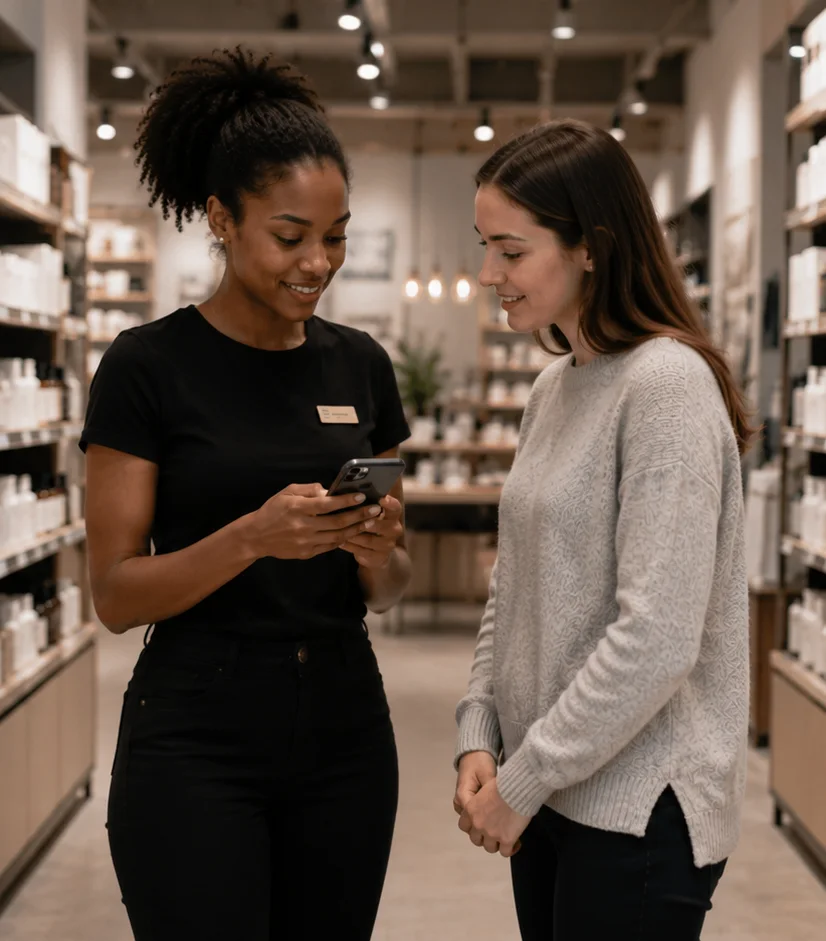
The shopper doesn't see turnover statistics. They see an associate who wants to help and can't — who has to find a colleague, walk to a terminal, or guess. The service floor holds or fails on whether the person standing there can answer, and today that depends entirely on how long they've happened to be employed. ShopVoices breaks that dependency: the same complete, store-aware answer, from a first-week hire or a veteran, on every shift.
The biggest retailers have already acted — by building it themselves
In-store AI assistants for associates are no longer an experiment. They are deployed, chain-wide, at the largest retailers in the world — and the results those retailers report are about exactly one thing: service quality from staff who are permanently new.
Lowe's — 1,700+ stores
Chain-wide since May 2025. Associates have asked more than 5 million questions, over half of interactions happen by voice, and the CEO reports 200 basis points of customer-satisfaction improvement from the companion tool.
Lowe's Q1 FY2026 earnings call, May 2026
Target — ~2,000 stores
Built an associate assistant and took it from a ~400-store pilot to roughly 2,000 stores in six months — framed by Target around store-team knowledge and speed of service, not revenue.
Target corporate disclosures, 2024–25
Sam's Club — every club
Walmart's Sam's Club associate assistant answers hundreds of thousands of associate questions a week — proof at the largest possible scale that staff genuinely use a store-knowledge assistant.
Walmart / Sam's Club corporate disclosures
Day-one associates who answer like third-year ones
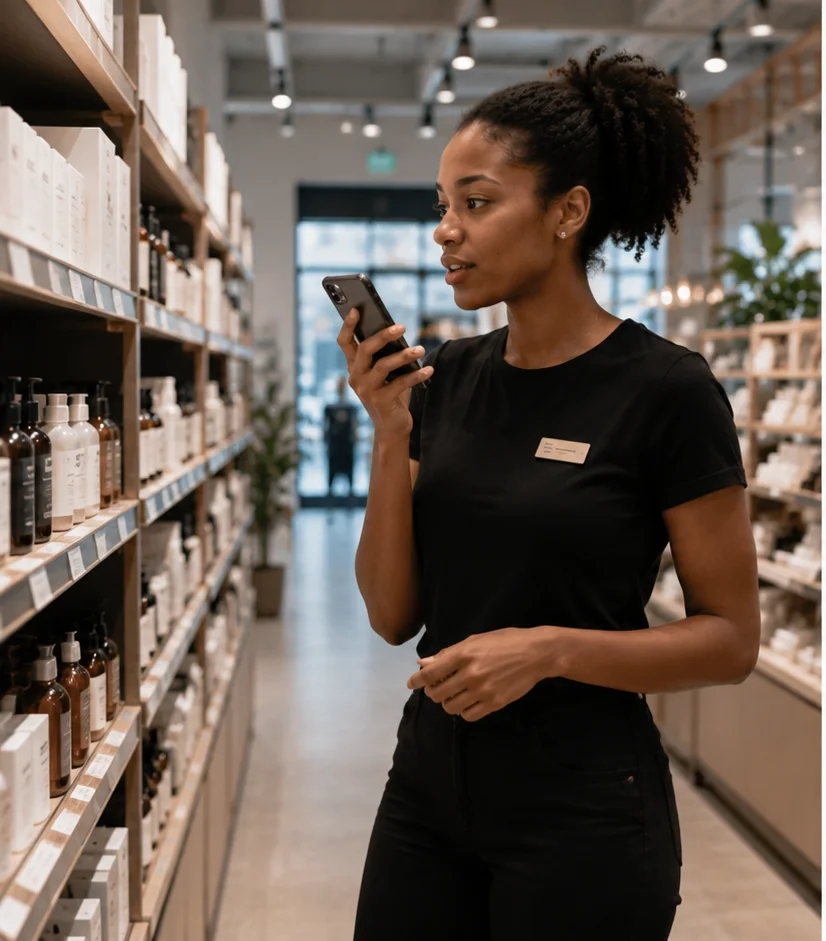
ShopVoices puts the store's complete, current knowledge — every product, price, stock state and shelf location — behind every associate and every self-service surface, in seconds, by voice. The consequence for onboarding is direct: someone in their first month answers a customer as accurately as someone in their third year, so service scores hold even when the roster doesn't.
- Your staffing plan does whatever it was already going to do — nothing about rosters or headcount has to change.
- New hires are productive on the floor from their first shift, not after a curriculum.
- The knowledge stays when people leave — it belongs to the store, not to tenure.
- European chains get what Lowe's built internally, without a top-ten retailer's engineering budget.
Measure it on your own floor
Run a focused pilot and measure what a store-knowledge layer does to first-contact resolution and service consistency — against your own baseline.